
The price on your supplier’s quotation is rarely the final cost of imported goods in Saudi Arabia.
A product quoted at SAR 50,000 may cost considerably more after freight, insurance, customs duties, import VAT, port or handling charges, customs clearance, and local transportation are included. If you only compare supplier prices, you can easily choose the wrong supplier.
The better approach is to calculate the landed cost before placing the order.
A simple starting formula is:
True Import Cost = Product Cost + Freight + Insurance + Customs Duties + Import Taxes + Clearance + Handling + Local Delivery + Other Applicable Costs
The exact calculation depends on the product, origin, shipping terms, HS classification, customs treatment, and other circumstances.
This guide explains how Saudi businesses can calculate the real cost of imported goods and compare international suppliers more accurately.
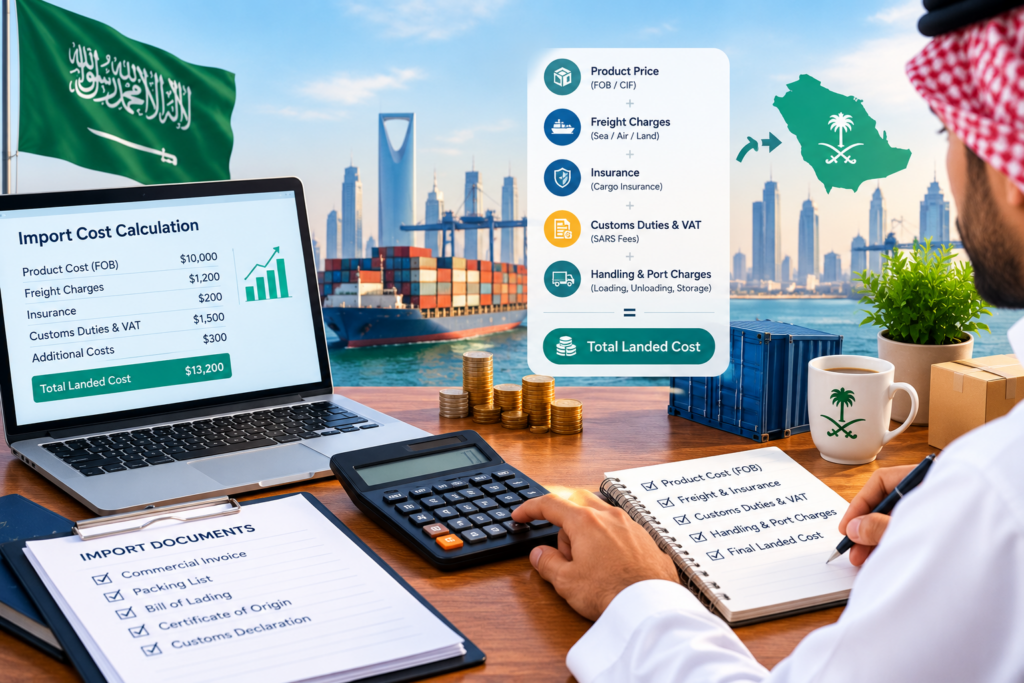
What Is the True Cost of Imported Goods?
The true cost of imported goods is the total amount a business incurs to purchase, import, clear, and receive the goods in Saudi Arabia.
It goes beyond the supplier’s invoice.
For example, imagine a logistics company Saudi Arabia receives a quotation for industrial equipment from an overseas supplier. The quotation may show only the equipment price, while the business still needs to account for international freight, insurance, customs duties, VAT, clearance and inland delivery.
That is why businesses should calculate landed cost, not simply purchase price.
What is landed cost?
Landed cost is the total cost associated with getting imported goods from the supplier to the buyer’s intended destination, including applicable purchasing, transportation, customs and related costs.
A useful internal calculation is:
Landed Cost = Purchase Price + International Logistics + Import Costs + Local Logistics
The exact items included should be defined consistently when comparing suppliers.
Why Is Landed Cost Important for Saudi Businesses?
Landed cost tells you what the imported product actually costs your business after the major import expenses are considered.
A supplier offering the lowest unit price may not offer the lowest final cost.
For example:
| Cost | Supplier A | Supplier B |
| Product price | SAR 45,000 | SAR 49,000 |
| Freight & insurance | SAR 8,000 | SAR 4,500 |
| Customs & other import costs | SAR 7,000 | SAR 5,500 |
| Local delivery | SAR 2,500 | SAR 1,500 |
| Estimated landed cost | SAR 62,500 | SAR 60,500 |
Supplier A looks cheaper at first.
Supplier B is cheaper after the full import costs are considered.
This is why procurement teams should compare total landed cost, not just supplier quotations.
What Costs Should You Include When Calculating Import Cost in Saudi Arabia?
Start with every cost that is necessary to get the goods from the supplier to your required destination.
The major categories usually include:
- Product purchase price
- International freight
- Insurance, where applicable
- Customs duties
- Import VAT
- Customs clearance
- Port and handling charges
- Inspection or certification costs, where applicable
- Warehousing or storage
- Local transportation
- Banking or payment-related charges
- Other applicable service fees
Not every shipment will contain every cost.
The correct calculation depends on the product and the agreed commercial terms.
Step 1: Start With the Supplier’s Product Price
The first number in your calculation is the amount paid or payable for the imported goods.
Suppose you are importing machinery with a supplier price of:
SAR 100,000
That is your starting point, not your final import cost.
Before using the figure, check what the supplier’s quotation includes.
Is it:
- EXW?
- FOB?
- CIF?
- DAP?
- Another Incoterm?
The answer can significantly change which additional costs your business needs to calculate.
For example, an FOB quotation and a CIF quotation do not represent the same level of transportation cost inclusion.
Step 2: Add International Freight
International freight is often one of the largest additional costs.
Your freight cost depends on factors such as:
- Country of origin
- Destination
- Shipping method
- Weight
- Volume
- Shipment type
- Cargo characteristics
- Delivery schedule
Sea freight may make sense for large, non-urgent shipments.
Air freight may be appropriate when speed is more important.
For heavy machinery or large construction materials, transportation can have a significant effect on the final landed cost.
Do not compare suppliers until the freight assumptions are reasonably comparable.
Step 3: Add Insurance Where Applicable
Insurance protects the shipment against certain risks during transportation.
If insurance is purchased separately, include the applicable premium in your landed-cost calculation.
This matters particularly for high-value machinery, equipment, fragile goods, or large commercial shipments.
Even when insurance represents a relatively small percentage of the total shipment, leaving it out can make supplier comparisons less accurate.
Step 4: Determine the Correct HS Code
The Harmonized System (HS) code is used to classify imported goods.
Correct classification matters because customs duties and other requirements can depend on the tariff classification.
ZATCA provides an Integrated Customs Tariff Inquiry that allows importers and suppliers to search customs duties using the tariff code, description, chapter or section.
Saudi Arabia also implemented the GCC integrated tariff at the 12-digit level from January 1, 2025, with the tariff system containing updated and amended items.
So do not simply copy an HS code from an old supplier invoice.
Confirm that the classification is appropriate for the actual product.
Step 5: Calculate the Customs Value
This is where import-cost calculations become more technical.
Saudi customs valuation generally uses the transaction value as the primary method, meaning the price actually paid or payable for goods sold for export, subject to the applicable valuation rules and adjustments.
ZATCA’s import guidance explains that the customs declaration uses the CIF value, which includes the cost of the goods, freight and insurance to the place of importation.
For example, suppose:
- Goods: SAR 100,000
- Freight: SAR 8,000
- Insurance: SAR 1,000
Your illustrative CIF value would be:
SAR 109,000
The actual customs valuation should follow the applicable Saudi/GCC customs valuation rules rather than an informal calculation.
Step 6: Calculate Applicable Customs Duty
Once the product classification and customs value are established, determine the applicable customs duty.
The rate varies according to the product’s tariff classification and applicable rules.
ZATCA provides an official tariff inquiry service where users can search customs duties using an HS code, product description or tariff category.
For example, if an illustrative shipment has a customs value of SAR 109,000 and the applicable duty were 5%:
SAR 109,000 × 5% = SAR 5,450
This is only an example.
Do not assume that 5% applies to your product. The actual rate must be checked against the current tariff classification.
Step 7: Add Import VAT
Import VAT is another major component to consider.
Saudi Arabia’s standard VAT rate is 15%, and ZATCA states that VAT is generally charged on imports of goods into Saudi Arabia, subject to applicable rules and exceptions.
Import VAT is not simply calculated by taking 15% of the supplier’s invoice price.
ZATCA’s guidance explains that import VAT is calculated based on the relevant import value, which can include the customs value, applicable customs duties and certain incidental charges.
For example, using simplified illustrative figures:
- Customs value: SAR 109,000
- Customs duty: SAR 5,450
- Other applicable taxable import charges: SAR 550
Illustrative VAT base:
SAR 115,000
At 15%:
SAR 17,250
Again, this is an example to explain the calculation structure. Your actual VAT calculation should follow the applicable ZATCA rules and customs declaration.
Is Import VAT a Real Cost for Your Business?
This question needs careful treatment.
For a VAT-registered business, import VAT may potentially be recoverable as input tax if the relevant conditions are met.
That means businesses should distinguish between:
Cash paid at import
and
Permanent economic cost
They are not always the same.
For internal procurement analysis, it can therefore be useful to show both:
- Gross landed cost including VAT
- Net landed cost after recoverable VAT, where applicable
Your accounting or tax team should confirm the treatment for your specific business and transaction.
Step 8: Add Customs Clearance Charges
Customs clearance is another cost that should appear in your import calculation.
A customs broker or import service provider may charge fees for handling the customs process.
ZATCA’s current import instructions state that importers must complete FASAH clearing procedures and submit the required documents and customs declaration at least 48 hours before shipment arrival at the port of entry.
Depending on the shipment, documentation may include:
- Commercial invoice
- Bill of lading
- Certificate of origin
- Product-specific documents
- Required certificates or registrations
ZATCA specifically lists the commercial invoice, bill of lading and certificate of origin among the standard documents, while additional documents can apply depending on the goods.
If you use a customs broker, include the agreed brokerage or clearance charges in your landed-cost model.
Step 9: Include Port, Handling and Storage Charges
These costs are easy to forget.
Depending on the shipment, you may encounter charges associated with:
- Port handling
- Terminal services
- Documentation
- Storage
- Container handling
- Inspection
- Demurrage or detention
- Other logistics services
Not every shipment will incur all of these charges.
But your procurement team should ask the logistics provider which charges are included in the quotation and which are excluded.
This is particularly important when comparing freight quotations from different providers.
A cheap freight quote can become considerably less attractive after excluded charges appear.
Step 10: Add Local Transportation
Your calculation should continue until the goods reach their intended destination.
For example:
Port → Customs → Warehouse → Factory
If local transportation costs SAR 3,000, add that amount to the landed-cost calculation.
For construction materials or industrial equipment, the final destination may be a project site rather than a warehouse.
That means local delivery distance, vehicle requirements and cargo dimensions can influence the final cost.
What Is the Formula for Landed Cost in Saudi Arabia?
A practical calculation can look like this:
Basic formula
Landed Cost = Product Cost + Freight + Insurance + Customs Duty + Clearance + Handling + Local Delivery + Other Applicable Costs
If you also want to calculate the gross cash requirement including import VAT:
Total Cash Import Cost = Landed Cost + Applicable Import VAT
However, avoid treating the formula as a legal tax calculation.
The exact customs and VAT bases depend on the applicable Saudi rules, product classification and import declaration.
ZATCA itself provides a customs and tax calculator, but clearly states that its calculator provides an approximate result and that the actual amount is determined through the customs declaration.
Example: How to Calculate the True Cost of Imported Machinery
Let’s use a fictional example.
A Saudi company imports machinery with these costs:
| Cost | Amount |
| Machinery price | SAR 100,000 |
| Freight | SAR 8,000 |
| Insurance | SAR 1,000 |
| Customs value | SAR 109,000 |
| Illustrative customs duty at 5% | SAR 5,450 |
| Clearance & handling | SAR 2,000 |
| Local delivery | SAR 3,000 |
| Other applicable charges | SAR 550 |
The estimated cost before import VAT would be:
SAR 120,000
If the illustrative VAT base were SAR 115,000, then 15% VAT would equal:
SAR 17,250
The gross cash amount associated with the import would therefore be approximately:
SAR 137,250
But remember: this example does not establish the actual duty rate, VAT base or recoverability of VAT for a real shipment.
For an actual transaction, confirm the product classification, tariff, customs valuation and applicable tax treatment.
Which Costs Are Most Often Forgotten?
The biggest mistakes usually come from costs that do not appear on the supplier’s initial quotation.
Commonly overlooked items include:
1. Freight
Businesses sometimes compare only the supplier’s product price.
2. Insurance
High-value cargo can make insurance relevant to the total cost.
3. Customs duty
The duty rate depends on the product’s classification.
4. Clearance charges
5. Port and handling charges
Broker and customs-related service fees can add to the final amount.
These can vary depending on the shipment and service provider.
6. Storage
Delays can create additional storage expenses.
7. Local delivery
Getting goods into Saudi Arabia is only half the journey.
8. Compliance costs
Certain products may require certificates, registrations or other approvals.
ZATCA specifically advises importers to check the Customs Tariff for product-specific conditions or consult a customs broker.
How Can You Compare Two International Suppliers Properly?
Do not compare Supplier A and Supplier B using their unit prices alone.
Instead, create a standardized comparison sheet.
For each supplier, record:
- Product price
- Incoterm
- Origin
- HS code
- Freight estimate
- Insurance
- Customs duty
- Import VAT
- Clearance
- Handling
- Local delivery
- Lead time
- Payment terms
- Warranty
- Other applicable costs
Then calculate the estimated landed cost per unit.
Example
Supplier A:
Total landed cost = SAR 120,000
Supplier B:
Total landed cost = SAR 114,000
Even if Supplier B’s product price was initially higher, its lower logistics and import costs could make it the better commercial option.
This is where professional sourcing becomes more valuable than simply finding the lowest quotation.
How Do Incoterms Affect Import Cost?
Incoterms define important responsibilities between buyers and sellers in international trade.
Terms such as EXW, FOB, CIF and DAP determine which party is responsible for particular transportation, delivery and risk-related obligations.
This affects how you calculate the cost.
For example, if your supplier quotes on an EXW basis, your business may need to arrange more of the transportation process.
A CIF quotation may already include the cost of goods, insurance and freight to the agreed destination port.
That does not mean all import costs are included.
Customs duties, taxes, clearance and local transportation may still need to be considered.
Always ask:
“Exactly which costs are included in this Incoterm quotation?”
That single question can prevent many unpleasant surprises.
How Can Businesses Reduce the True Cost of Imports?
Once you calculate the full landed cost, you can identify where the money is going.
Instead of negotiating only the supplier’s product price, look at the entire cost structure.
Compare Multiple Suppliers
A slightly higher product price may come with significantly lower freight or better payment terms.
Consolidate Shipments
Where practical, combining shipments may improve logistics efficiency.
Negotiate Freight
For recurring imports, compare freight providers rather than accepting the first quotation.
Reduce Documentation Errors
Incorrect documentation can cause delays and additional charges.
Check Product Classification Early
Confirm the tariff classification before finalizing the transaction.
Compare Incoterms
Different Incoterms can shift costs between buyer and seller.
Plan Delivery Before Shipping
Knowing the final destination and local transport requirements helps avoid last-minute logistics expenses.
Work With an Experienced Import Partner
A sourcing and import partner can help coordinate suppliers, freight, documentation and delivery instead of leaving the buyer to manage each stage separately.
Can an Import Export Company Help Reduce Landed Cost?
Yes, a capable import-export company can help businesses control landed costs by managing more than the supplier relationship.
The useful question is not simply whether the company can import goods.
Ask whether it can help with:
- International supplier sourcing
- Supplier comparison
- Procurement
- Freight selection
- Documentation
- Customs coordination
- Product compliance
- Shipment tracking
- Warehousing
- Local delivery
The value comes from coordinating the entire process.
For Saudi businesses importing industrial machinery, construction materials, automotive parts, medical equipment or energy-related products, the logistics and compliance side can be just as important as the supplier price.
How Does AZM Alsafwa Help With International Sourcing and Imports?
AZM Alsafwa positions its import-export service around global sourcing, procurement, import/export management, logistics and distribution.
The company also operates across related industrial areas, including construction, energy management, water and waste treatment, and industrial supplies.
This gives businesses an option when an import requirement is connected to a larger project rather than being a simple one-off shipment.
For example, an industrial or construction project may require international supplier sourcing, equipment procurement, import coordination and delivery to the project location.
In that situation, the goal is not simply to find the cheapest supplier.
It is to find the best combination of product price, quality, logistics, compliance, delivery time and total landed cost.
What Is the Best Way to Calculate Import Costs in Saudi Arabia?
The safest approach is to calculate the cost before placing the purchase order.
Start with the supplier’s quotation and Incoterm. Then establish the correct product classification, estimate freight and insurance, check the applicable customs duty, account for clearance and handling, calculate applicable import VAT, and add local delivery and other relevant expenses.
For current tariff and customs information, use official ZATCA resources rather than relying on an old spreadsheet or a generic online calculator. ZATCA provides both an Integrated Customs Tariff Inquiry and a Customs and Tax Calculator.
The calculator can help with estimates, but ZATCA states that its results are approximate and that the actual amount is determined through the customs declaration.
Final Import Cost Checklist
Before approving an international purchase, check the following:
| Cost / Factor | Checked? |
| Product purchase price | ☐ |
| Incoterm | ☐ |
| Supplier country | ☐ |
| HS code | ☐ |
| Customs value | ☐ |
| International freight | ☐ |
| Insurance | ☐ |
| Customs duty | ☐ |
| Import VAT | ☐ |
| Customs clearance | ☐ |
| Port/handling charges | ☐ |
| Inspection/certification | ☐ |
| Storage | ☐ |
| Local transportation | ☐ |
| Other applicable charges | ☐ |
| Final landed cost per unit | ☐ |
Conclusion
The true cost of imported goods in Saudi Arabia is rarely the price shown on the supplier’s quotation.
Businesses need to consider the entire journey: supplier price, Incoterms, freight, insurance, customs valuation, tariff classification, customs duties, import VAT, clearance, handling, storage and local delivery.
The biggest lesson is simple:
Do not ask only, “How much does the product cost?” Ask, “How much will it cost us when it reaches its final destination in Saudi Arabia?”
That number gives your procurement team a much better basis for comparing suppliers, negotiating prices and deciding whether an import is commercially worthwhile.
For complex or recurring imports, working with an experienced import-export and sourcing partner can also reduce the amount of coordination your internal team has to manage while improving visibility over the total landed cost.



